Free · Vietnam
Vietnamese Dong: Count the Zeroes Before You Pay
Vietnamese prices can look alarming when you are new to the currency. A simple lunch may have five or six digits, a hotel bill may have seven, and the banknotes in your wallet may differ by only one zero. The arithmetic is not difficult. The danger is doing it while tired, hurried, or distracted.
This guide gives you a repeatable transaction check. It works at a café, market, ticket desk, hotel, pharmacy, shop, or transport counter. It does not require you to memorize a live exchange rate, and it does not assume that every merchant uses the same payment system.
The core habit is:
Read the full dong amount, group the last three digits, show the amount, and check the change before leaving.
Vietnam's currency is the đồng. The State Bank of Vietnam uses VND as the international abbreviation and đ in the domestic market. Its official currency page lists legal-tender banknotes and coins and describes the banknote denominations. That official list is the best reference for what the issuer has issued; what you actually encounter in daily transactions will depend on the place and amount.
First: stop translating every price into your home currency
A conversion can help you understand the scale of a purchase. It is a poor substitute for reading the amount you are actually paying.
Exchange rates move. Your bank, card network, cash exchange service, or ATM may use different rates and fees. If you stare only at a converted number, you can miss a much simpler mistake: paying 500,000 VND when the agreed amount was 50,000 VND.
Use two separate questions:
- What is the exact amount in VND?
- Is that amount acceptable to me in my own budget?
Answer the first question before reaching for a conversion app.
The three-digit grouping that makes long prices manageable
Start from the right and separate the amount into groups of three digits.
Accessibility note: the middle dot (·) below is only a visual thousands-group separator. A screen reader may pronounce it as “dot”; the complete amount is also written with standard comma grouping.
| Written amount | Read it as groups | Useful spoken mental form |
|---|---|---|
| 20,000 VND | 20 · 000 | twenty thousand dong |
| 50,000 VND | 50 · 000 | fifty thousand dong |
| 200,000 VND | 200 · 000 | two hundred thousand dong |
| 500,000 VND | 500 · 000 | five hundred thousand dong |
| 1,250,000 VND | 1 · 250 · 000 | one million, two hundred fifty thousand dong |
| 3,600,000 VND | 3 · 600 · 000 | three million, six hundred thousand dong |
Different screens, receipts, and handwritten signs may use commas, periods, spaces, or no separators. Do not rely on the punctuation alone. Count from the right.
For example:
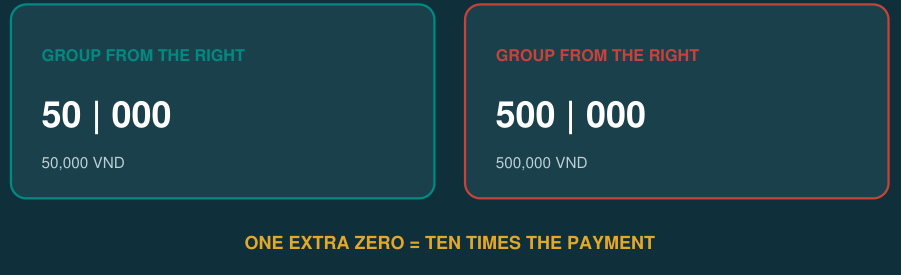
50000becomes50 | 000.500000becomes500 | 000.1250000becomes1 | 250 | 000.
If a price is abbreviated as 50k or 50K, the intended meaning is often 50,000, but do not make that an automatic rule. Ask the seller to show or enter the full VND amount. An abbreviation is not a good place to guess.
Know the notes you are most likely to confuse
The State Bank of Vietnam's official page lists polymer banknotes of:
- 500,000 VND
- 200,000 VND
- 100,000 VND
- 50,000 VND
- 20,000 VND
- 10,000 VND
It also lists lower-value cotton-paper banknotes. The official page describes each note's denomination, material, dimensions, colours, and front and back designs.
Do not identify a note by colour alone. Lighting changes colour, notes wear, and two denominations may look surprisingly similar when folded or handed over quickly. Read the printed denomination.
The highest-risk pairs for a hurried visitor are not universal, but the pattern is predictable:
- 20,000 versus 200,000
- 50,000 versus 500,000
- 10,000 versus 100,000
Each pair differs by one zero and a factor of ten. Build a small pause around those notes.
The factor-of-ten pause
When two plausible amounts use the same leading digits, compare the three-digit groups instead of staring at the string of zeroes.
| Smaller amount | Larger amount | The group that changes |
|---|---|---|
| 20 · 000 | 200 · 000 | 20 becomes 200 |
| 50 · 000 | 500 · 000 | 50 becomes 500 |
| 100 · 000 | 1 · 000 · 000 | a new million group appears |
For an amount ending in 000, briefly ignore that final group and read what remains on its left. If the price is 50 | 000 but the terminal or note is 500 | 000, stop: the payment is ten times larger. This visual check works even when you do not know the current exchange rate.
The note check
Before handing over a note:
- Hold it flat enough to see the full printed denomination.
- Read the number from left to right.
- Say the amount silently: “fifty thousand,” not merely “fifty.”
- Compare it with the displayed or agreed price.
- Hand over only that note or a clearly counted combination.
This takes two seconds. It is faster than trying to reconstruct a transaction afterward.
The seven-step payment check
Use the same sequence regardless of whether you pay by cash, card, or an accepted digital method.
1. Establish the unit
Ask what the price covers:
- one item or the whole order;
- one person or the group;
- one night or the entire stay;
- one kilogram, one portion, one ticket, or one trip;
- base price or price including additions.
The wrong unit can matter more than a misplaced zero.
2. Get the full amount in VND
Ask the merchant to point to, write, or enter the complete amount. A calculator screen can help, but check what the number represents.
Write it here if the purchase matters:
Item/service: ____________________ Amount: ____________________ VND
3. Group the digits
Start at the right and make the groups of three.
____________________ → ________ | ________ | ________
4. Reconcile additions
If the total is higher than the menu, shelf, or booking price, ask what was added. Possibilities may include extra items, quantity, service charges, taxes, deposits, delivery, or a simple error. Do not accuse; reconcile.
Useful English-first prompt:
“Could you show me how this total was calculated?”
If communication is limited, point to each line and use a calculator. A visible calculation is better than rapid back-and-forth guessing.
5. Choose the payment method deliberately
Confirm which methods the merchant actually accepts before completing the transaction. Do not assume a card logo, QR display, or booking-app listing guarantees that your particular card or account will work.
If using a card or device:
- read the amount on the terminal before approving;
- keep the card in view where practical;
- do not enter a PIN into an unfamiliar phone form or message link;
- keep a backup method available;
- review the receipt or banking notification for the VND amount.
If using cash, state or show what you are handing over.
6. Calculate expected change before it arrives
Use subtraction:
cash given − agreed total = expected change
Examples:
| Agreed total | Cash given | Expected change |
|---|---|---|
| 42,000 VND | 50,000 VND | 8,000 VND |
| 135,000 VND | 200,000 VND | 65,000 VND |
| 480,000 VND | 500,000 VND | 20,000 VND |
| 1,250,000 VND | 1,500,000 VND | 250,000 VND |
For the last example, 1,500,000 means three 500,000 notes. Count the notes and the total; do not treat “1.5” as a currency amount without context.
7. Count change and keep the evidence
Count change while you are still at the counter. Read each note's denomination rather than judging the stack by colour or thickness.
If the transaction is important, keep the receipt, booking record, or payment notification. Check that it matches the item, date, and amount. A receipt is useful evidence; it is not proof that every part of the transaction was correct.
Four worked transactions
Example 1: a menu uses 45K
You see 45K beside a dish. Do not silently decide whether the price is 45,000 VND and order several items. Point to the item and ask the server to show the full amount for one portion.
The server enters 45000 on a calculator.
Your check:
- Group it as
45 | 000. - Confirm it is one portion.
- Order.
- At payment, reconcile the number of portions and any additions.
Example 2: a market total is spoken quickly
You understand “two hundred,” but not whether the seller means 200,000 VND or a quantity-related figure. Handing over a 200,000 note may happen to work, but it does not confirm understanding.
Ask for the total on a calculator or phone screen. The seller shows 280000.
Group it as 280 | 000, then ask whether that is the total for all items. If paying 500,000 VND, calculate 220,000 VND change before handing over the note.
Example 3: a card terminal shows 1,800,000
Your hotel or tour booking record shows 1,080,000 VND. The digits are the same but the order is different.
Do not approve and assume the difference is a fee. Compare the booking lines. Ask the provider to explain and correct or document any legitimate addition. Only approve the amount you understand and accept.
Example 4: change is returned in several notes
The total is 320,000 VND and you hand over 500,000 VND. Expected change is 180,000 VND.
One possible correct combination is:
- 100,000
- 50,000
- 20,000
- 10,000
Count the values, not the number of notes: 100 + 50 + 20 + 10 = 180 thousand.
A one-minute wallet setup
You can reduce errors before a purchase starts.
- Place larger notes in one section and smaller notes in another.
- Keep 20,000 and 200,000 notes from overlapping.
- Keep 50,000 and 500,000 notes from overlapping.
- Face notes in the same direction so the denomination is visible.
- Before paying in a queue, select the likely note without displaying your whole wallet.
- Keep a small emergency reserve separate from routine cash.
Do not reorganize cash openly in a crowded or uncomfortable place. The purpose is accuracy and discretion, not displaying funds.
When the amount does not match
A mismatch is not automatically fraud. It may be a quantity error, an omitted promotion, an extra item, a misheard price, a terminal entry error, or a misunderstanding about the unit. Respond in a way that preserves evidence and makes correction easy.
Use this correction sequence
- Pause the transaction. Do not approve, tap, or hand over more money.
- Show the earlier price or agreement. Use the menu, label, message, or booking record.
- Show the current total. Put the two figures side by side.
- Ask for the calculation. Identify quantity and additions.
- Agree on the corrected full VND amount. Avoid shorthand.
- Pay only after the display is correct.
- Keep evidence if the disagreement matters. Record the merchant, time, item, amount, and response accurately.
Do not surrender a passport as an informal guarantee for an ordinary retail disagreement. If a provider has a legitimate identity or deposit procedure, understand it before committing.
Cash, card, and QR: the amount check does not change
The payment rail changes, but the editorial rule stays the same.
Cash
Main risk: wrong note, wrong change, or no clear record.
Control: read the note aloud in your head, state what you gave, calculate change, and retain a receipt for material purchases.
Card
Main risk: approving a mistyped amount, dynamic currency choice you do not understand, duplicate processing, or an issuer block.
Control: read the terminal, keep the receipt, and compare the VND transaction notification. If a payment appears to fail, check before authorizing repeated attempts.
QR or account-based payment
Main risk: wrong recipient, altered code, wrong amount, or a method unavailable to your account.
Control: start from the merchant's verified checkout flow, confirm recipient and VND amount, and do not scan a replacement code sent by an unverified stranger. A screenshot saying “successful” is not a substitute for checking your own transaction record.
What this guide cannot tell you
It cannot tell you:
- today's exchange rate;
- whether your foreign card or wallet will work at a particular merchant;
- whether a particular banknote is genuine based on a text description;
- what fees your bank, ATM, card network, or money changer will apply;
- whether a disputed charge legally entitles you to a particular remedy.
For current exchange and payment terms, use your financial provider's official information. For the appearance and features of Vietnamese currency, use the State Bank of Vietnam's official currency pages. If you suspect a serious payment problem, preserve the evidence and use the appropriate official provider, bank, or authority channel.
The full-amount confirmation strip
Use this when a spoken price, abbreviated sign, calculator display, terminal, or receipt does not line up. It keeps the conversation focused on the number rather than on guessing.
| Check | Confirmed entry |
|---|---|
| Item, service, quantity, or period | |
| Displayed or quoted amount | |
| Complete amount in digits | ____________________ VND |
| Additions explained | |
| Final agreed total | ____________________ VND |
| Cash handed over, if any | ____________________ VND |
| Expected change | ____________________ VND |
The seller and buyer should be looking at the same complete number before payment. If the displayed figure is abbreviated, rewrite it without k or K, a decimal-style shorthand, or an omitted group of zeroes.
Ninety-second zero-count drill
Cover the answer column and read each amount as a full VND value. The goal is not speed alone; it is noticing the tenfold jump created by one extra zero.
| What you see | Your grouping | Answer |
|---|---|---|
45000 |
45 · 000 = 45,000 VND | |
450000 |
450 · 000 = 450,000 VND | |
1.250.000 |
1 · 250 · 000 = 1,250,000 VND | |
1080000 |
1 · 080 · 000 = 1,080,000 VND | |
1800000 |
1 · 800 · 000 = 1,800,000 VND | |
50K |
Ask for the full display; if confirmed, 50 · 000 = 50,000 VND |
Now calculate before checking:
- Total 285,000 VND; cash handed over 500,000 VND. Expected change: 215,000 VND.
- Two items at 120,000 VND each plus one at 45,000 VND. Expected total: 285,000 VND.
- Booking record 1,080,000 VND; terminal 1,800,000 VND. Difference: 720,000 VND. Pause and reconcile before approving.
If any answer required guessing what a shorthand meant, repeat the useful real-world action: ask for the complete VND amount.
Pocket checklist
Before paying:
- [ ] What is the unit: item, person, night, kilogram, ticket, or total?
- [ ] What is the complete amount in VND?
- [ ] Have I grouped the last three digits?
- [ ] Do quantity and additions explain the total?
- [ ] Does the cash note or terminal show the intended amount?
Before leaving:
- [ ] Did I calculate and count the change?
- [ ] Does the receipt or notification match?
- [ ] Did I keep evidence for a material purchase?
The point is not to become a currency expert. It is to make one clean decision at a time: unit, full amount, digits, payment, change, evidence.
Official source checked
- State Bank of Vietnam, Vietnamese Currency (issuer, monetary unit, legal-tender status, banknote denominations and note descriptions), page dated 25 July 2025 and checked 23 October 2026: https://sbv.gov.vn/en/vietnamese-currency
Official information controls if it differs from this article. Prices, acceptance methods, exchange rates, and provider fees must be checked at the actual transaction.